
Warming up before training should be a pretty simple topic. But, as with a lot of things involving resistance training, it can get complicated quickly. A big reason for that is the amount of pressure placed on the expected benefits of warming up. There is often an assumption that warm-ups will prevent injury or produce exceptional gains in performance.
But does warming up actually do those things? Where is the line between sensible preparation and overpromising benefits? And how should you approach warm-up sets if you are newer to resistance training or have never really thought about them before?
The goal of this article is to help you understand what a warm-up is meant to do and how to apply it in a practical way.
Let’s dive in.
What is warming up?
You’ll note the title of this article is warming up for resistance training, which means this isn’t about aerobic, cardio, endurance, or sport-specific warm-ups that can have different factors and reasoning. For this article, we are going to focus on how these changes relate to performance and training readiness for resistance training, such as strength or hypertrophy.
The biggest factor to keep in mind while absorbing this information is that warming up should be, first and foremost, about getting you warmer. When you go from sitting or very low-intensity activity to an exercising state, a range of physical processes begin to take place that help prepare you for movement, from increases in muscle temperature to improved neuromuscular readiness.
As for how to warm up, the conversation and research can range from walking on a treadmill to more explosive lifts. I’m not going to get too deep into every aspect of warm-ups (spoiler: I’m not really going to cover foam rolling). But this article should cover the general ideas well enough that you can gauge for yourself what might be most useful, which is always the goal here at MacroFactor.
Let’s look at the different types of warm-ups:
General: Any light aerobic movement that increases heart rate and raises body temperature. The main goal is to increase muscle temperature and prepare the body for general neuromuscular readiness.
Stretching: This includes static or dynamic stretching or movement work and can also include antagonist stretching.
Tissue prep: This typically includes things like foam rolling or other forms of manual soft tissue work.
Specific warm-up: This is where you perform the exercise or work muscle groups you’re planning to train, but at a lighter load before your working sets. This category can also include heavier or more explosive preparation strategies, such as post-activation performance enhancement approaches.
Now that we have a general idea of some key terms, let’s start by examining one of the main reasons people think about warm-ups: injury prevention.
Injury and rates of injury for resistance training
Regarding strength and hypertrophy styles of resistance training, I want to lead with the fact that we do not have a large body of direct evidence of warm-ups in relation to injuries. And it sort of makes sense when you consider the realities of research funding and priorities. It is often more practical to study high-profile injuries in sports, like ACL tears in pro football players, than what is happening to a 30-year-old lifter in the gym doing an upper/lower split.
That said, we do have some research to review.
A helpful starting point is to examine what tends to get hurt during resistance training. A 2025 narrative review by Kawa et al identified the shoulder, lower back, knee, and hand or wrist as the most commonly reported injury locations in resistance training settings.
To be clear, this review does not establish causation. However, it is useful for helping us understand general patterns. Across the literature, most reported injuries we are seeing in resistance training tend to be mild strains, sprains, or tendon-related issues that resolve with rest or training modification.
While the Kawa et al paper focused on injury identification, a systematic review by Tung et al looked at injury incidence across studies. They reported a range of roughly 2.4 to 3.3 injuries per 1,000 hours of training in weightlifting and 1.0 to 4.4 injuries per 1,000 hours of training in powerlifting. It is also worth noting that some of the injury data in weightlifting and powerlifting includes competitions.
Comparatively, in sports like soccer (football), you see a much steeper increase during competition. Injury rates are typically around 3.7 injuries per 1,000 hours during training, but increase to about 36 injuries per 1,000 hours during matches.
| Example of injury rates in resistance training versus competitive sport: | ||
| Activity | Setting | Injury rate (per 1,000 hours) |
| Weightlifting | Training (and some competition exposure) | 2.4 to 3.3 |
| Powerlifting | Training (and some competition exposure) | 1.0 to 4.4 |
| Soccer (Football) | Training | ~3.7 |
| Soccer (Football) | Matches | ~36 |
In short, resistance training tends to have a relatively low injury risk compared to many other sports and activities. That doesn’t mean injury prevention isn’t important, but when you consider research funding priorities, it’s easier to understand why direct evidence in this area is a little thin.
So, now that you know how often and where injuries tend to occur, the next step is to examine whether warming up helps reduce injury risk.
Do warm-ups help prevent injury?
Again, with a caveat that resistance training injury prevention is not a heavily studied topic in and of itself, let’s dive into what we do have.
One of the more commonly cited papers on this topic is a 2014 systematic review and meta-analysis that examined exercise interventions as a whole (not warm-ups specifically). They found that strength training programs in general were associated with reduced injury risk, while static stretching alone showed little preventive effect.
If we look at static stretching more specifically for warm-ups, one argument has been that improving range of motion over time could be helpful, especially if limited mobility changes how a movement is performed or increases stress on a joint or muscle. However, it is probably best to separate that discussion into short-term and long-term effects. Even then, you also have to consider alternatives, such as using strength training itself to improve mobility or movement tolerance.
For example, a 2025 systematic review, meta-analysis, and multivariate meta-regression found that both acute and chronic stretching can reduce stiffness, but only chronic stretching produced more meaningful stretch tolerance and sustained range of motion. And to be clear, much of the stretching examined in this review involved repeated sessions performed over weeks to months, not just brief stretching performed as just part of a pre-training warm-up.
With dynamic movements, you are usually working through a range of motion under some level of force. And in general, if there is going to be a small hiccup in coordination or comfort, one could argue it’s better to experience that with a lighter load before progressing to heavier working sets. And while there is some research to consider, there are limitations when it comes to direct application to resistance training. Much of the work in this area focuses on sport performance or requires more consistent, repeated exposure over time.
For more specific warm-ups or adding any resistance training or re-warm ups, the research usually dives into more sports like golf, baseball, or basketball. We can certainly learn from these studies, but in general, it’s worth being cautious about making direct translations to resistance training.
Injury take-home:
Resistance training tends to fall on the lower end of injury occurrence and severity compared to other sport activities, and the benefits of participating in resistance training clearly outweigh avoiding it altogether.
There are not many studies that directly compare different warm-up types or systems specifically for injury prevention in resistance training. From a mechanistic standpoint, you can make logical arguments for why certain warm-up approaches might help place you in a better position to avoid injury, but the current evidence does not allow us to draw clear cause-and-effect conclusions on any specific type of warm-up at this time.
What about performance or hypertrophy outcome and warm-ups?
It would seem that there isn’t a large body of evidence examining warm-ups and injury risk, at least not research specifically tailored to resistance training. Much of the discussion relies on inference and mechanistic reasoning. So what about performance? Are there clearer lines to draw, or more obvious benefits or drawbacks?
Let’s take a brief look at a few different types of warm-ups and how they may affect performance.
Stretching
Stretching also comes up frequently in discussions about performance, not just injury risk. Over the last decade, there has been ongoing debate about whether static stretching is detrimental to performance. In general, the duration of the stretch appears to be the biggest factor.
If you’re heading into a situation that requires greater force production, such as an explosive lift, you likely want to avoid longer static stretch holds. There is some flexibility in the exact timing, but the main concern is prolonged stretching that may temporarily reduce force production. Shorter stretches that are part of a general warm-up or combined with dynamic movement do not appear to have the same effect.
Dynamic stretching has received more favorable outcomes in recent years and has shown some potential for improving performance. However, the improvements tend to be small, and there are still relatively few long-term studies that focus directly on resistance training.
One study from Benine et al, examined both dynamic and static stretching performed before resistance training over an 8-week period. In this study, the static stretching condition totaled roughly 80 seconds, while the dynamic stretching condition involved a series of limb movements taken through a full range of motion. And the third group performed no stretching.
All groups completed the same training program, and all groups showed similar improvements in strength and muscle thickness, with no meaningful differences between them.
Antagonist stretching is another consideration. The idea is that stretching the opposing muscle group could potentially improve performance in the working muscles. For example, stretching the chest and anterior shoulder muscles before performing a seated row. The research for this topic is in its early days, but there have been some small positive results (here, here, and here).
One recent 2025 study examined whether antagonist static stretching for 40, 80, or 120 seconds affected strength and power performance compared with no stretching (the control). They tested this in young, recreationally active men, who performed different durations of stretching before doing their lifts that included isometric contractions and slow and fast isokinetic movements.
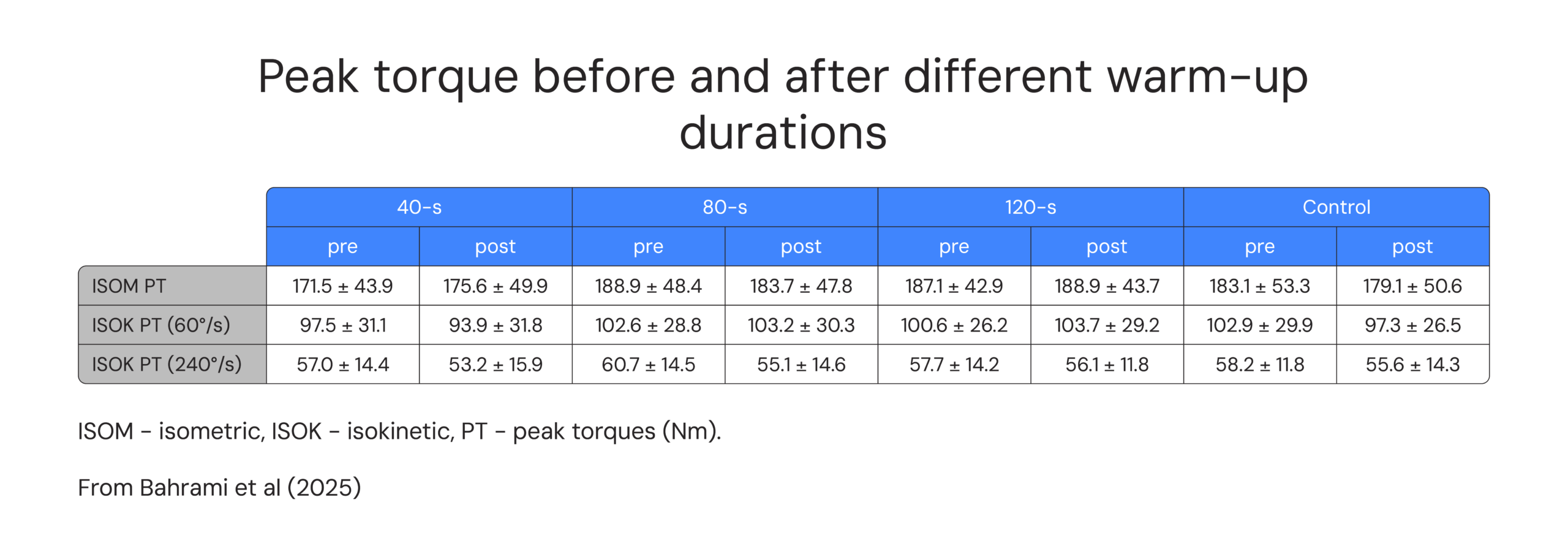
Overall, the antagonist stretching did not meaningfully change performance outcomes. So, this isn’t to say there couldn’t be something with antagonist stretching, just that it’s likely pretty small and the circumstance more specific.
Take-home regarding stretching and performance
Static stretching could potentially have a negative effect on performance depending on how close it occurs to your training session and how long the stretch is held.
That said, some dynamic movements can take you through ranges of motion in a more explosive manner. Therefore, it is usually worth starting with a small amount of general movement, even something as simple as a short walk, before moving into more intensive dynamic stretching. I think it’s sensible to warm up by practicing the movement you are about to perform, and gradually expose your body to the load and demands of that task. This keeps the focus on preparation and capacity, which is ultimately what matters.
Lastly, research on antagonist stretching is mixed. Short-duration antagonist stretching is unlikely to harm performance, but it also may not provide a meaningful benefit.
Specific versus general warm-ups
A general warm-up can vary, ranging from walking on a treadmill to cycling or other light aerobic activity. A useful way to think about a general warm-up is that you’re not trying to practice the exact movement or muscle groups before the exercise. Instead, the goal is to raise body temperature, increase readiness, and improve blood flow.
Specific warm-ups can vary in research definitions as well, but they usually involve preparing the same muscle groups that are about to be used in the exercise. In resistance training, this often means performing warm-up sets and gradually increasing the load until you reach your working sets. In some cases, it may also involve a related movement, such as performing push-ups before a bench press.
Starting with the general warm-up side of things, a recent 2025 systematic review and meta-analysis with meta-regression examined 33 studies to determine whether increases in muscle temperature improve maximal force, rate of force development, and power output. The researchers found improvements in power and rate of force development, but little to no meaningful change in maximal force.
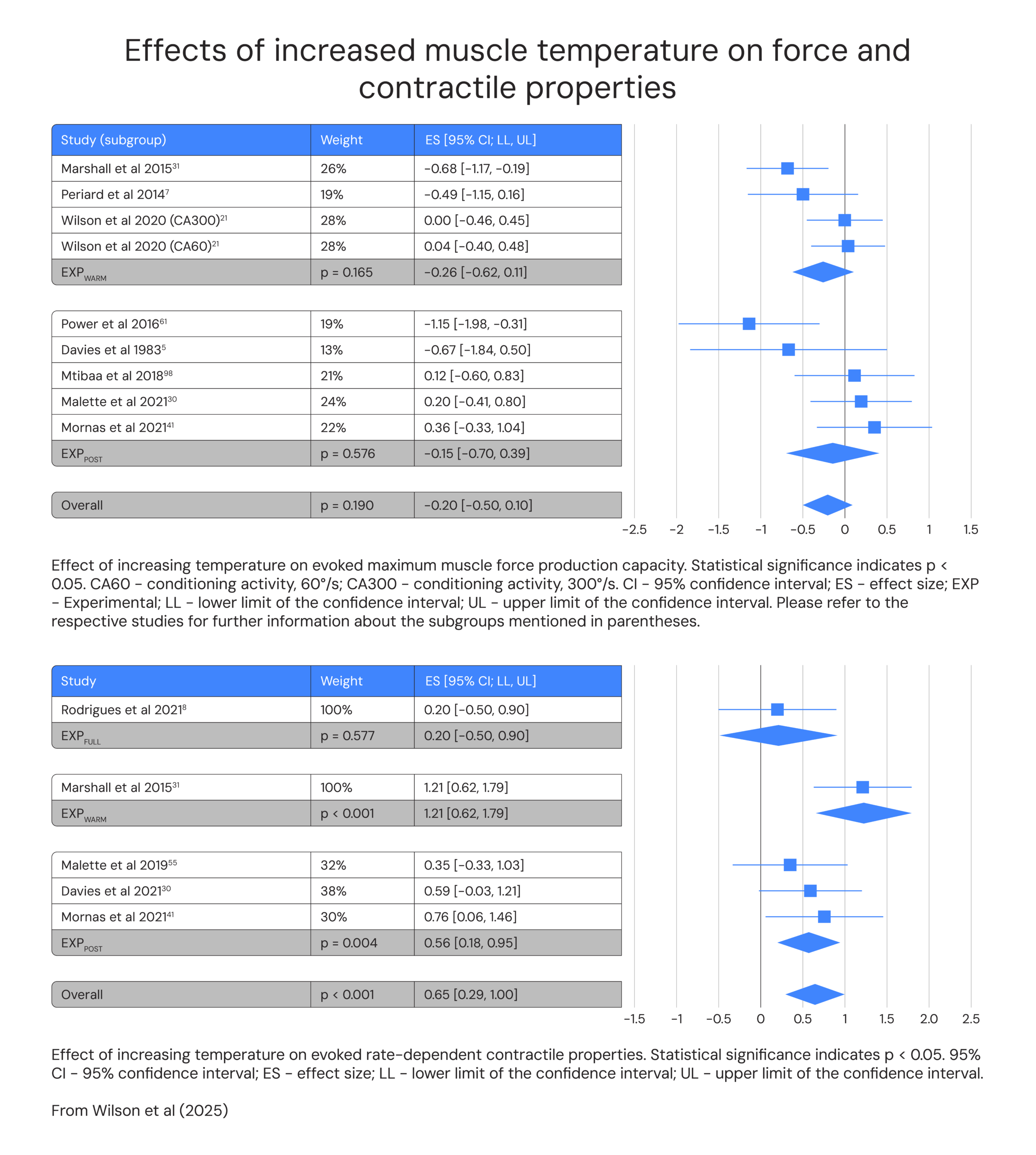
In more plain terms, this means that in a warmer state, your muscles might contract a little faster and produce power more quickly, but it is probably not going to make a big difference in your peak strength.
Do we see a difference when we jump into more specific warm-ups versus general?
A 2021 narrative review examined 11 studies on different warm-up strategies and their effects on muscular performance. Overall, the findings were mixed. Some studies showed improvements in strength or performance, while others showed little to no effect. However, most of the studies reported either positive or neutral outcomes, with very few showing negative effects. That said, individual study design and training context still matter when interpreting these results.
Looking at some more recent research on this topic, one 2024 study by Viveiros et al examined 15 men in their twenties who had at least 6 months of resistance training experience. Each participant completed three separate training conditions, with each condition using a single warm-up set at a different load percentage.
| Warm-up condition performance comparison | ||||
| Warm-up condition | Load (% of 10RM) | Reps | Volume vs other conditions | Statistical outcome |
| Low-load | 40% | 15 | Lower than high-load | p = 0.038 |
| Moderate-load | 60% | 10 | Lower than high-load | p = 0.010 |
| High-load | 80% | 5 | Highest performance | Reference condition |
They took each set of exercise to failure (3 total) and rested between sets for 2 minutes. The exercises included the bench press, an incline leg press, and a wide-grip lat pulldown. In this study, performance showed a slight advantage for the higher-load warm-up condition.
A recent 2025 study from Enes et al looked at 29 trained men and women in their twenties using a randomized crossover design (meaning each participant completed every condition). Participants completed three different warm-up strategies: 1 set of 3 to 4 repetitions at 75% of their 10RM load, 2 sets of 3 to 4 repetitions at 55% and 75% of their 10RM load, and a control condition in which no specific warm-up was performed. The performance was tested at several time intervals after the warm-up.
The researchers found that heavier or more explosive warm-ups sometimes improved performance, but not consistently. Fatigue and recovery likely played a role in that variation, which highlights the need to balance readiness with fatigue. In other words, the goal of a warm-up is to help you perform your main lift, not to turn the warm-up into the workout itself.
There are also some practical points to take away from this study when thinking about hypertrophy. In this case, the different warm-up strategies did not meaningfully change how many repetitions participants completed or the total amount of work performed during the working sets. Since hypertrophy is strongly tied to total work and sets performed close to failure, this could suggest that the warm-up itself was not contributing much to muscle growth. Instead, the warm-up is more likely preparing the lifter to perform the work that actually drives hypertrophy.
What about postactivation performance enhancement, or PAPE?
This also gives us a chance to dig a little more into the concept of postactivation performance enhancement, or PAPE. Just as there is growing interest in approaches like antagonist stretching, there is also increasing attention on strategies that use heavier or more explosive movements before a main lift. In simple terms, PAPE refers to performing a heavier or more explosive movement before your working sets of the same muscle group, such as performing a heavy single bench press before your normal bench press sets.
Quite a few papers have examined this idea (here, here, and here), and most of them are really looking at heavier, more specific warm-ups. As we are seeing, this approach can sometimes improve short-term performance. However, the size of the effect raises a fair question about whether it meaningfully stands out from more traditional warm-up sets. We also still need more direct research in resistance training settings.
A new 2026 study used a randomized crossover design to test half-squats performed for 3 sets to failure, comparing a traditional warm-up with a postactivation performance enhancement (PAPE) condition that included a heavy conditioning activity followed by a longer rest period. This was a small study of 9 young, college-aged men who were trained but not advanced lifters. The researchers found that the PAPE condition led to slightly better performance and higher total training volume across the three sets compared with the control condition. And again, rest duration may have played a role here for modest results.
Another recent study from Souza et al had 14 men in their twenties perform parallel back squats. They had to at least be able to squat their body mass and have an average of about 9 years of resistance training experience. The researchers compared lower- and higher-load conditioning activities across multiple sets of back squats, using a Smith machine to standardize the movement.
In this study, heavier or lighter conditioning activities did not meaningfully improve performance across multiple sets. However, a small benefit was observed in the first set, suggesting that any advantage from the warm-up condition may be short-lived.
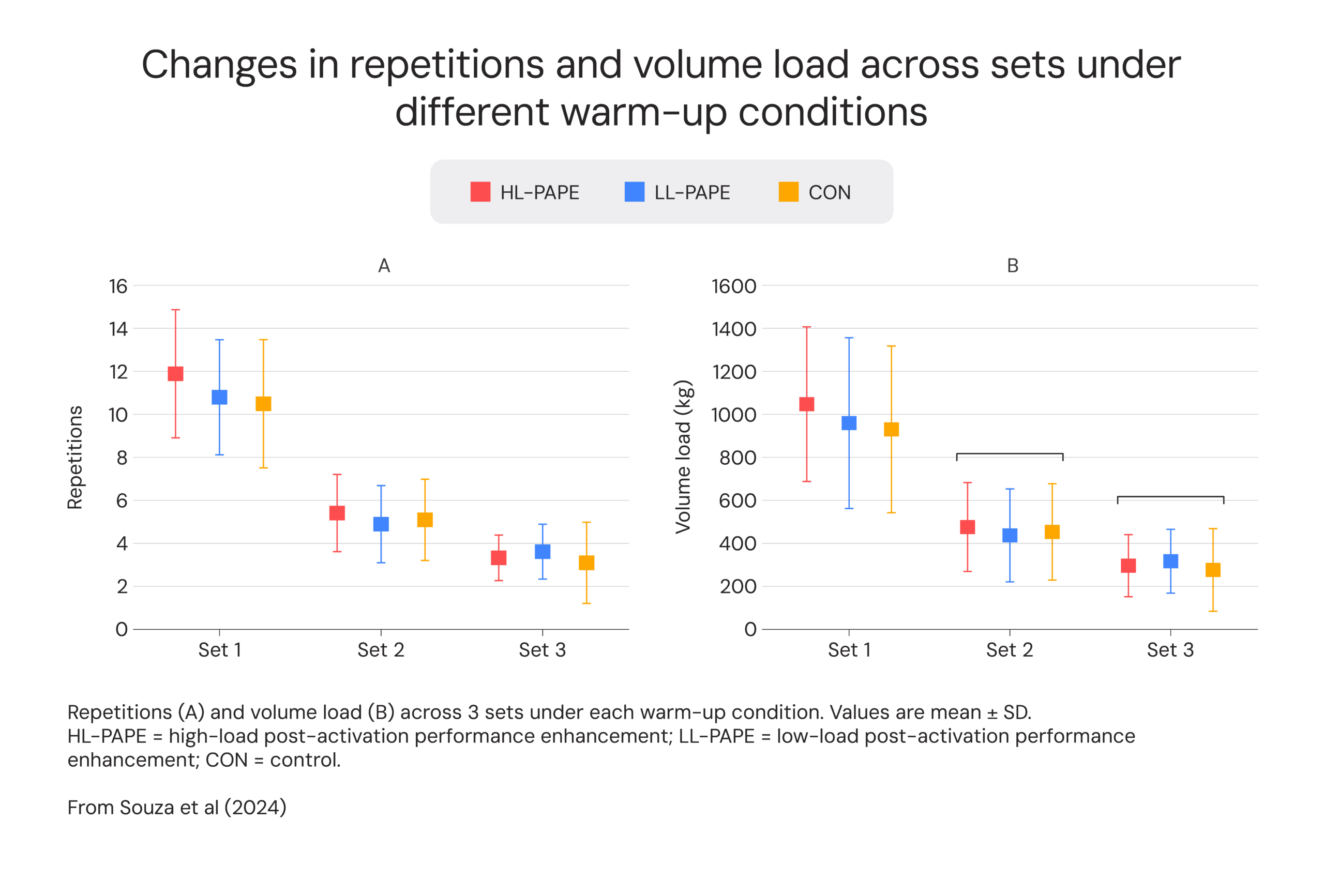
This is a good example of the back-and-forth pattern we keep seeing on this topic. It’s not to say that there isn’t something there, just that there is still a lot of clarity to be gained.
Take-home on warm-ups for performance
Overall, it is still difficult to pinpoint exactly where performance improvements from warm-ups are coming from, but there is enough evidence to suggest that some type of specific warm-up can lead to a neutral or modest positive effect on performance. That said, building up with heavier warm-up sets or explosive movements may provide a small edge for some people, but it can also introduce fatigue. While there could be performance benefits, there is also a risk of reducing performance if the warm-up becomes too demanding and starts to resemble a working set.
In the next section, we will move into some practical tips and walk through how to perform more traditional warm-up sets if you are new to them.
Practical framework for implementing warm-up sets
Now that you have a better understanding of different types of warm-ups, let’s shift to practical advice. The goal here is to help you find the sweet spot between getting warm enough to support performance without doing so much that you feel fatigued before your working sets begin.
Decide whether you need general or specific warm-ups
Depending on how your training days are structured, you may not need much more than a small amount of general movement to get warm, such as a few minutes on a treadmill or bike before starting your session. If your training session does not include heavier compound lifts, you can usually keep warm-ups simple and avoid overthinking load progression.
The heavier the load, the more specific warm-ups start to matter. And in general, it usually makes the most sense to focus more on specific warm-ups for your biggest lifts. That said, some people prefer to run through a quick round of each exercise at a reduced load just to get the feel of the movement before training. There is nothing wrong with including a specific warm-up for any exercise, but giving them more attention is usually most useful for the lifts that place the highest demands on your body.
Learn how to progress loads
Let’s assume you’ve decided to include warm-up sets before your working lifts. One of the easiest things to remember is that warm-up sets should gradually increase in weight while the reps decrease.
For example, if your working set is 275lb for 5 reps, a progression might look like:
| Example warm-up progression for a 275 lb working set | |
| Set | Load and reps |
| Warm-up 1 | 40% × 5 reps (about 110 lb) |
| Warm-up 2 | 60% × 5 reps (about 165 lb) |
| Warm-up 3 | 80% × 3 reps (about 220 lb) |
| Working set | 275 lb for 5 reps at 2 RIR |
That’s it. And you can use this progression as a general model for warm-ups, and make adjustments for different types of lifts.
For example:
- Compound lifts may use 3 warm-up sets.
- Isolation exercises may use fewer sets.
- Core or lighter movements may skip warm-ups entirely.
This allows you to match the warm-up with the demands of the exercise.
In the MacroFactor Workouts app, this process can be handled automatically. If you enable warm-up automation or use a preset scheme, the app will calculate warm-up sets based on your target weight using the same progression logic.
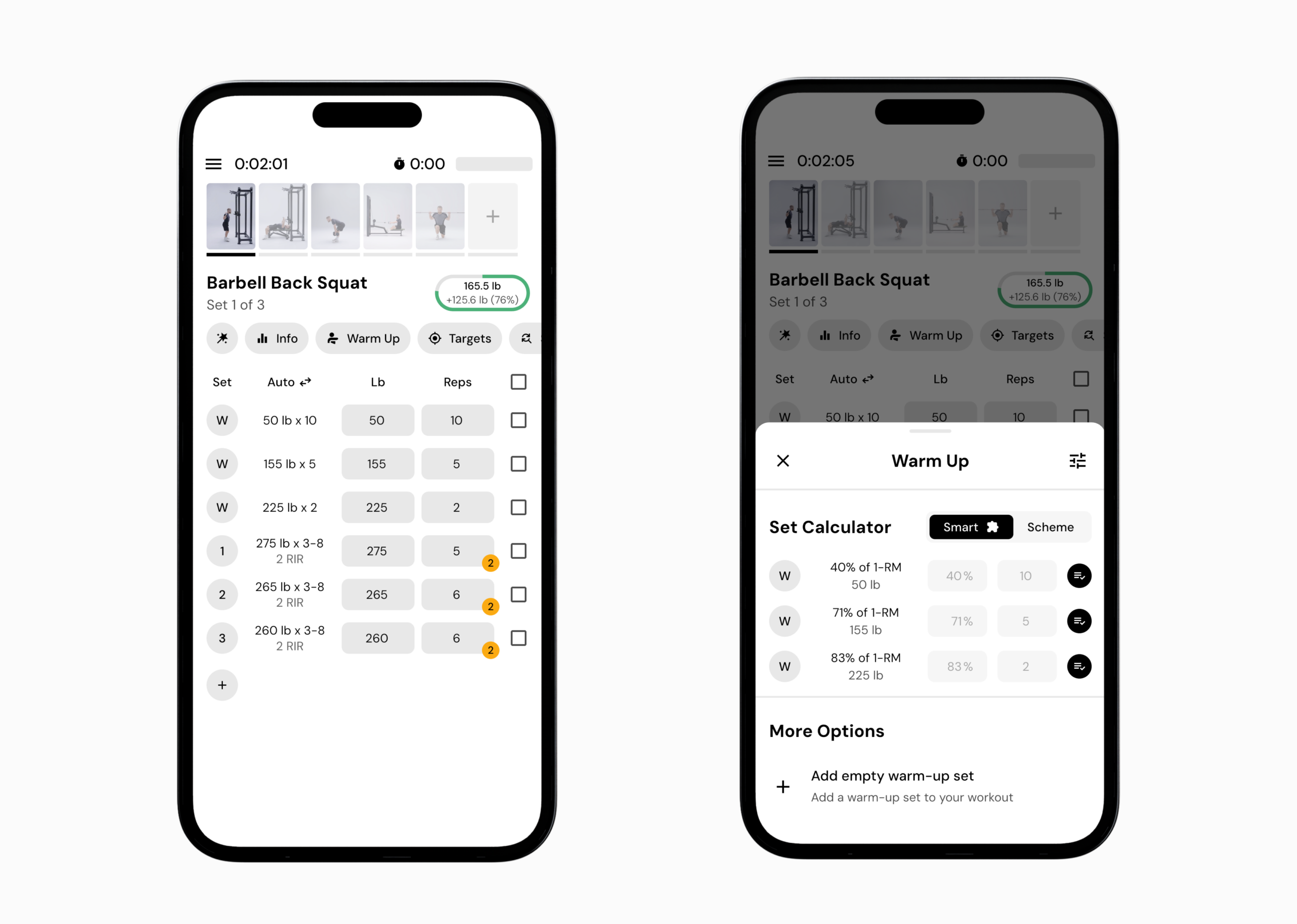
And remember, you only to warm-up enough to feel prepared. If you reach a 60% warm-up set and already feel ready to move into your main lift, there is no requirement to continue to an 80% set. You can simply transition into your working sets.
There should always be a bit of self-regulation involved in warming up. Some days you may need several gradual steps, while on other days you might feel ready after just an empty bar and one heavier percentage jump. These examples are simply meant to serve as examples for people who are not used to structured warm-ups or who are curious about trying them for the first time.
Pay attention to joint comfort and general readiness
If you are returning to training after a period of time off or are in an older age bracket, warm-ups can be helpful for general joint comfort and minor aches. This is not about preventing injury, and the topic can get nuanced, but at a basic level it is about helping your joints feel ready to move.
You can do this with a general warm-up, a few lighter warm-up sets, or by gradually moving a joint through its working ranges before heavier training. Sometimes that alone can make the session feel more comfortable. For example, if you are planning to do overhead pressing, you might start with a set or two of light external rotations with a cable machine. Nothing heavy, just higher-repetition work to move the shoulder through its working ranges and get some blood flowing. After that, you would move into your normal pressing work.
If you are not sure which movements to use, tools like the exercise library in the MacroFactor Workouts app can help identify exercises that target the joint or muscle group you are about to train. That can be especially useful when you are easing back into training or trying to find movements that feel comfortable.
Closing
There is no right way to warm up, and we are still lacking a lot of specific evidence for warm-ups in resistance training. That might be surprising, given how common warm-ups are in the gym. That said, we do have enough information to form some practical, sensible guidelines.
Here are a few points to keep in mind:
- Keep warm-ups simple. You don’t need complicated or long warm-up sessions. A good warm-up should only take a few minutes early in your workout. Then, prioritize based on whether you are performing compound or accessory lifts.
- Strength performance may benefit more than hypertrophy. We just don’t see strong evidence that warm-ups meaningfully affect muscle growth on their own.
- Warm-up needs may vary from day to day. Adjust the number of sets or intensity based on how prepared you feel.
- Stretching type matters, but the effects are pretty small. Dynamic or antagonist stretching tends to look slightly more favorable than longer-duration static stretching, but the differences are modest and results are mixed at best.
- Specific warm-up sets might help performance, especially for larger compound lifts. The heavier the planned load, the more useful gradual load increases tend to be.
- Progress gradually as you warm up. Loads usually increase while repetitions decrease as you get closer to your working sets.
- Find the balance between readiness and fatigue. Warm-ups should prepare you for the lift, not become a workout in their own right.
- More targeted, joint-specific warm-ups could help improve joint comfort. Moving a joint through its working range with light resistance might help reduce stiffness and make training feel a little better.