
For some, rest time in between workout sets is an opportunity to sit and watch a quick video. For others, rest times feel like an inconvenience and are kept to the bare minimum. But are you hurting your performance by rushing your rest, or is it really not that big of a deal?
This article covers practical information you need to know, including how long you may need to rest between sets, whether different training goals require different rest times, and how to approach rest if you’re struggling to fit it in.
Let’s dig in.
The ideal point of rest times is to help you recover enough between sets to serve your goals. The right amount of rest needed will depend on your goal and how much your performance drops from set to set.
For muscle growth, about 1-2 minutes can work well for many sets. Smaller isolation exercises may need less time, while heavier compound lifts may need more. The main goal is to keep volume high enough for growth.
For strength, about 3-5 minutes is a practical range for many hard sets. Heavy compound lifts, low-rep sets, or near-rep-max work may need longer. Performance is the goal so keep in mind that supporting performance with the rest times is key.
This article also covers time management and organizing your training to help with practical application.
What do rest times do between sets?
With topics like these, it’s best to zoom out and consider what you’re looking to achieve with rest times, rather than treating them like an abstract rule you should simply follow. The best place to start is to look at what rest is actually doing for you between sets.
When you lift, you’re asking your muscles to produce force, and this comes with an energy cost. That cost will vary depending on your training factors such as volume, exercise selection, or how close you’re training to failure. For instance, a biceps curl (an isolated exercise) is mostly going to create local fatigue in the muscles doing the work. In contrast, a compound exercise like a squat will demand more from multiple muscle groups, increase your heart rate more, and create a higher overall metabolic demand.
So, what happens when we stop a round of lifting?
We start recovering, and that break gives your breathing, heart rate, and muscles time to settle so that you can push toward your next set.
At its simplest, rest is about giving yourself enough time to recover so you can perform again.
How do rest times work with different set styles?
One quick point that can be confusing for less experienced trainees is the distinction between rest times between sets and set styles that intentionally manipulate rest during the active round.
For example, let’s say instead of doing straight sets, you’re doing a style of programming like myo reps. With myo reps, you take the first set pretty close to failure, rest for 15 seconds, do another set close to failure, rest again for 15 seconds, and then finish your final round of that set. That whole sequence is one round or one full set. After that set is complete, your rest time clock starts.
There can be some differences in how programs define these setups, but a simple way you can look at it is this: If multiple exercises or mini-sets are part of that set style, your rest time starts once that whole sequence is finished.
With that clear, let’s look at the difference between rest times for muscle growth and strength, and how to think about rest time in relation to your goals and the amount of time you actually have to train.
Rest times for muscle growth
When it comes to adding muscle, there are still details and mechanisms we do not fully understand. People still debate the best way to think about muscle growth, from rep ranges to mechanical tension and everything in between. But for our purposes here, let’s say that muscle growth generally comes down to creating enough mechanical tension, training close enough to failure, and getting in enough high-quality volume over time.
And to be clear, that is a simplification of a very complex topic. But for this discussion, the question comes down to whether rest time helps or limits those training factors.
Do shorter rest times limit muscle growth?
Let’s start with a study by Schoenfeld et al that helped shift the conversation about rest times, because hormone spikes and shorter rest periods had dominated the narrative up to that point. This study lasted eight weeks and included two groups of resistance-trained men. Both groups performed seven exercises for 3 sets of 8-12 reps to failure. They had one group rest for 1 minute, while the other rested for 3 minutes.
For muscle thickness, the longer-rest group showed a slightly greater increase in some muscles than the shorter-rest group.
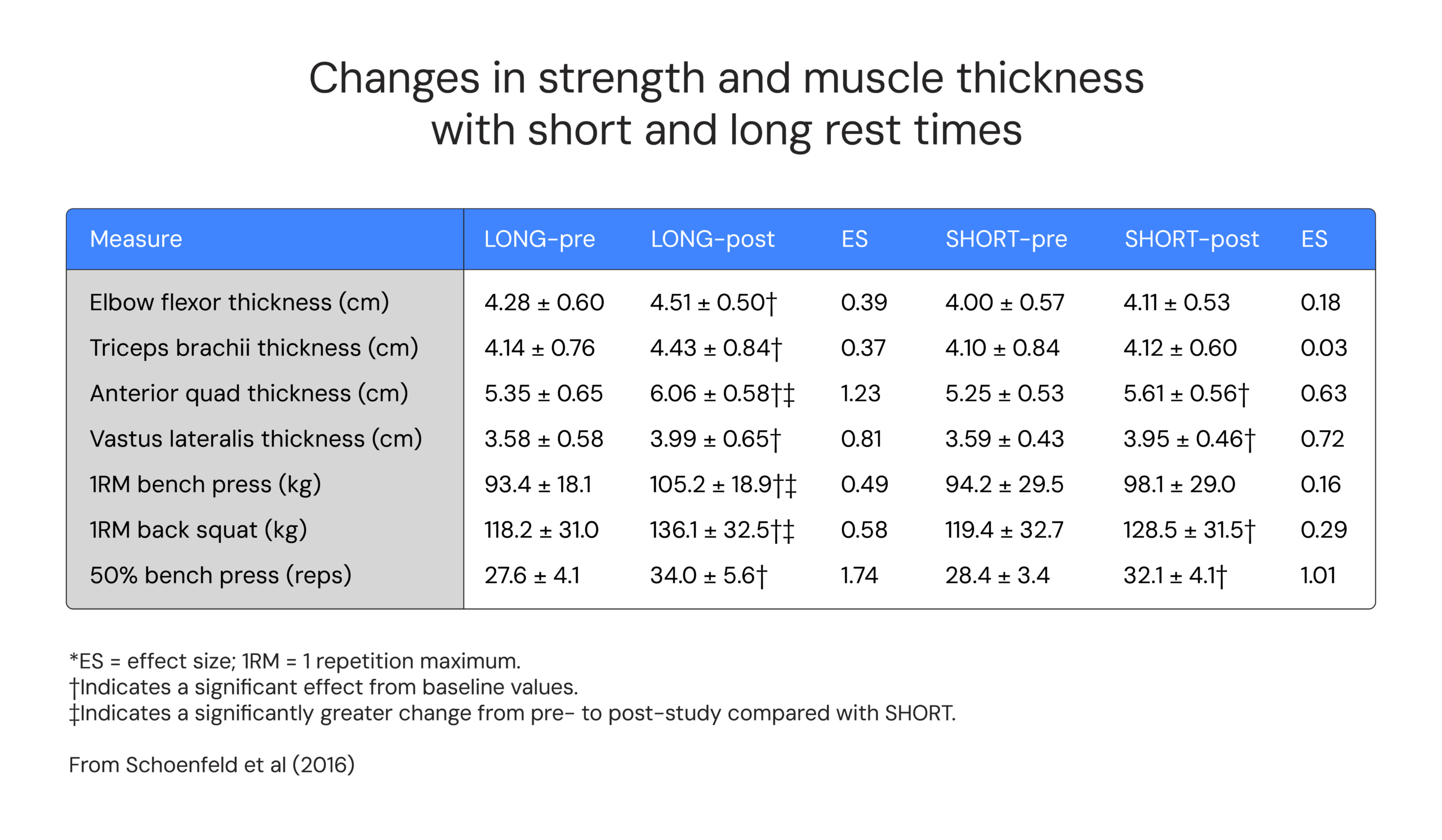
While the results weren’t dramatic, they did provide some clarity on short-term hormone spikes and opened the door to other areas of focus. It also helped move the conversation toward volume, varied rest times, and a clearer view of what we might be trying to achieve with rest during a session.
A systematic review from Grgic et al came out shortly after looking at six studies that compared 60 seconds or less of rest against longer rest times. It found that the longer rest times offered a small advantage for muscle growth compared with rest times that were under 60 seconds.
This led to more debate. Did the difference come from rest time itself? Did the rest time provide time to complete more volume within a workout? After all, it’s logical to think that shorter rest times could lead to less recovery, which could reduce total volume or too many variables on proximity to failure.
Does rest time matter, or does training volume matter more?
A study from Longo et al leans into answering some of these questions. It took untrained athletes and had them perform a unilateral leg press two times a week for 10 weeks, using either one-minute or three-minute rest times. Half of the subjects performed three sets with three minutes of rest between sets with one leg. With their other leg, they performed as many sets as were required to match the volume load of their first leg while resting for one minute between sets. The other half performed three sets with one minute of rest between sets with one leg. With their other leg, they performed as many sets as were required to match the volume load of their first leg while resting for three minutes between sets.
| Rest time, strength, and hypertrophy comparison | |||
| Condition | Rest time | Strength result | Hypertrophy result |
| Long rest | 3 minutes | 1RM increased 27.6% | Quadriceps CSA increased 13.1% |
| Short rest | 1 minute | 1RM increased 26.5% | Quadriceps CSA increased 6.8% |
| Short rest matched to long-rest volume | 1 minute | 1RM increased 31.1% | Quadriceps CSA increased 12.9% |
| Long rest matched to short-rest volume | 3 minutes | 1RM increased 31.2% | Quadriceps CSA increased 6.6% |
The results showed that the higher-volume conditions produced more quad growth, regardless of their rest time. In this study, the growth seemed to track more closely with volume load than rest time itself.
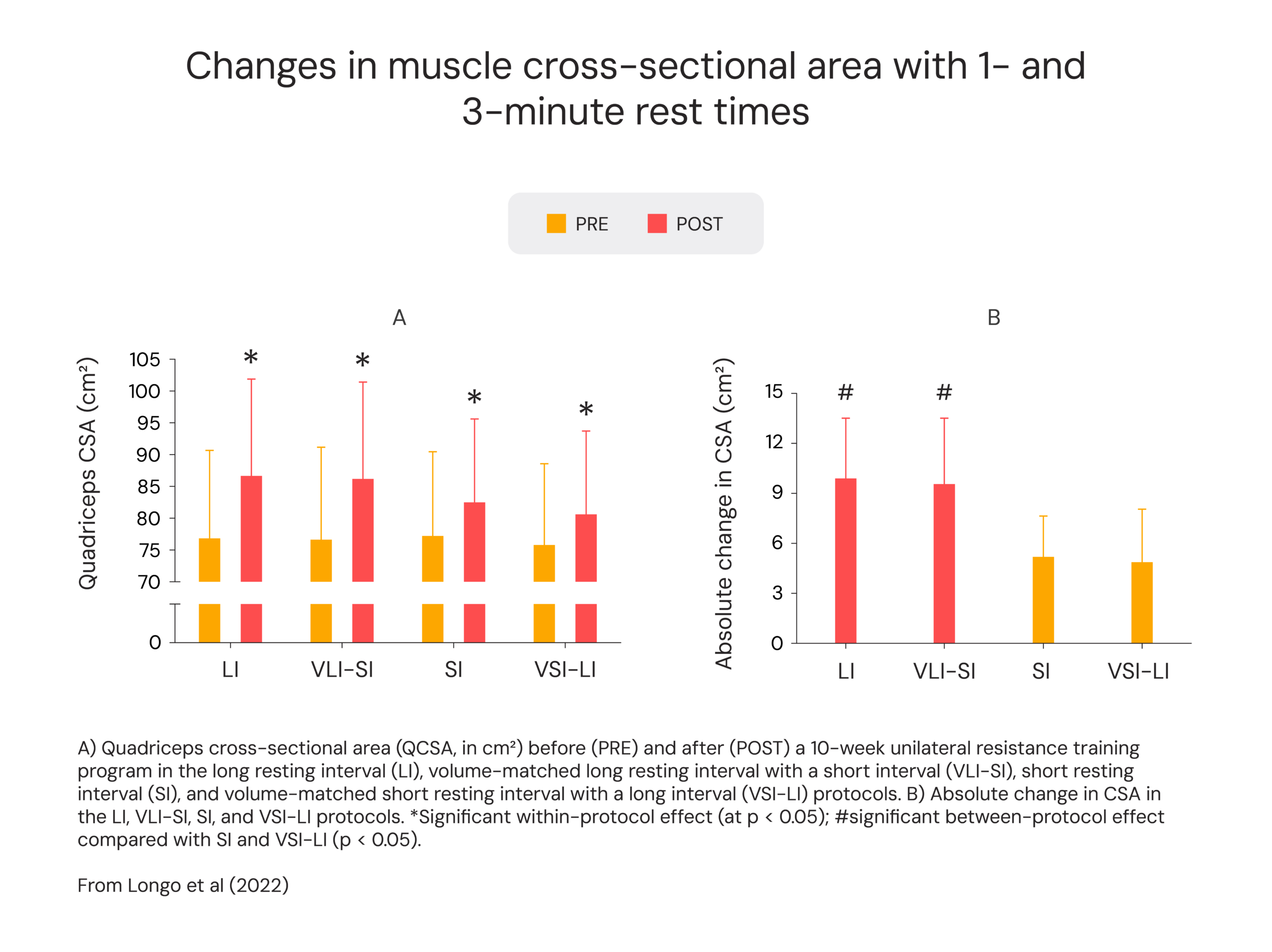
I wouldn’t treat this single study as a “case closed” answer on rest times or overstate its importance. But it still adds to the broader idea that rest time may matter partly because it affects how much quality work you can complete.
A more recent systematic review and Bayesian meta-analysis from Singer et al looked at nine studies and compared four ranges of rest times and their effects on hypertrophy.
| Rest time categories in the Singer et al meta-analysis | |
| Category | Practical meaning |
| Short | 1 minute or less |
| Intermediate | More than 1 minute, but less than 2 minutes |
| Long | 2 minutes to just under 3 minutes |
| Very long | 3 minutes or more |
Overall, muscle growth occurred across all the rest time categories. The results slightly favored resting longer than 60 seconds for arm and thigh measurements, but there was some overlap between categories. The intermediate range had the largest effect estimate, but, again, it’s important to note all the variables at play, from measurement techniques to how close sets were taken to failure.
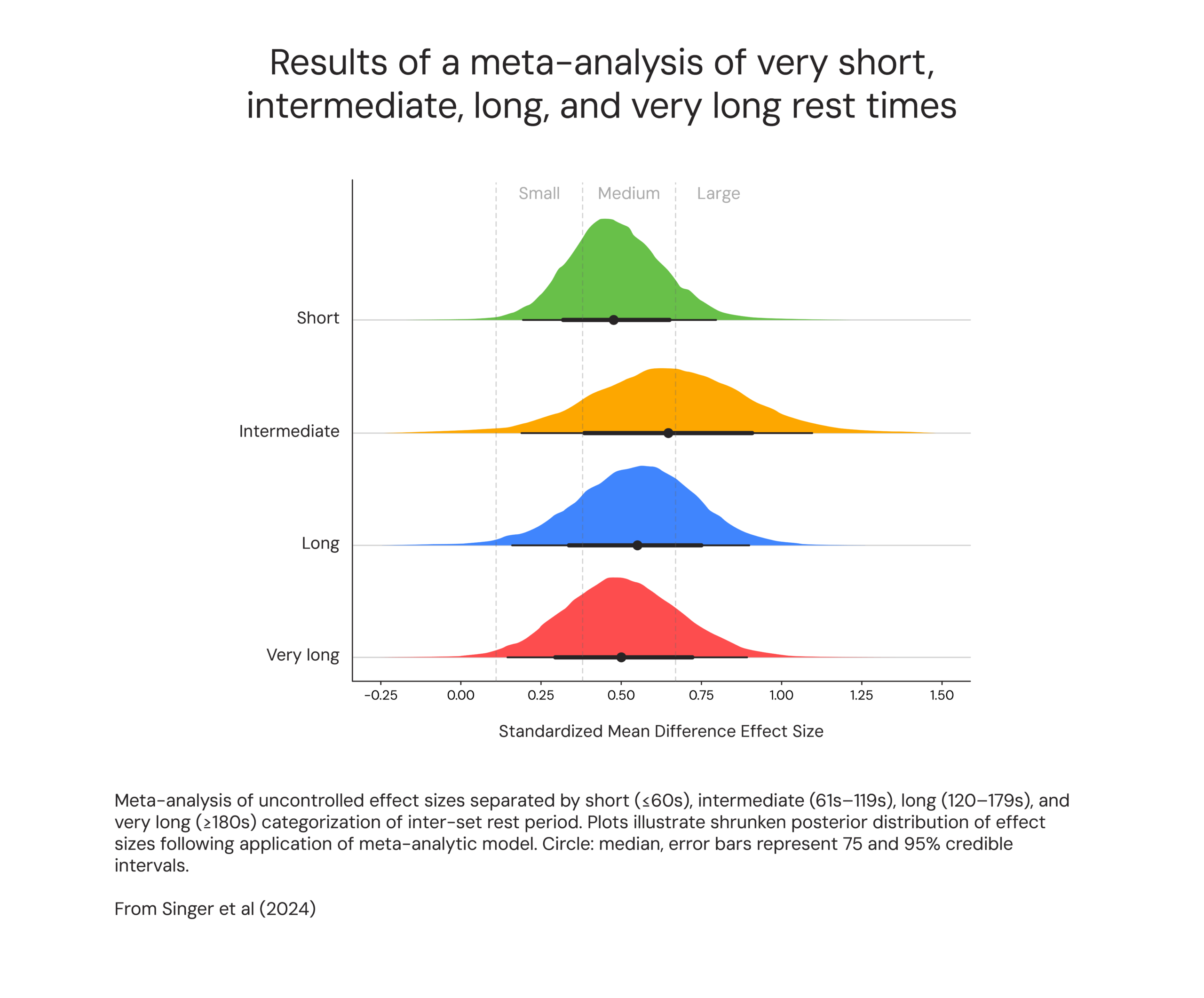
Can we safely say from the Singer et al study that going too short on rest will hinder muscle growth? I’d be careful with the absolutism of the wording, but it leans toward rest times that are a little longer. Some also use this study to say that longer rest times are worse for muscle growth, and I wouldn’t take that away from these results either. Mostly, this gives us a range to consider for more examination.
One of the last studies I’ll throw into the ring is a recent 2026 paper from Attarieh et al, which had 17 untrained young men train knee extensions twice per week for 10 weeks. One leg trained with 2 minutes of rest between sets, while the other trained with 20 seconds of rest. Importantly, the shorter-rest condition performed additional sets as needed to match the total number of repetitions completed in the longer-rest condition.
The results showed no significant differences in muscle growth or knee extension strength between those two conditions. It’s worth noting that the study was done in untrained young men, used a single-joint exercise, and could have had possible order effects because the exercise order was not alternated.
Key takeaways for rest times and muscle growth
Overall, for muscle growth, context matters here. Lots of variables can affect your rest needs from exercise selection to program design. A short rest after leg extensions is not going to be affected the same as a short rest after back squats. So, the details matter.
That said, I’d argue we can’t really say short rest times are bad for muscle growth. A better way to put it is that short rest times could be a problem if they reduce the amount of productive work and volume you can complete.
If I had to lean in one direction, I’d lean toward slightly longer rest times because they usually give you more opportunity to perform well. That said, it’s still hard to pin down exactly how long rest periods need to be, or where the benefits start to level off.
| Key takeaways for rest times and muscle growth | |
| Question | Practical takeaway |
| Are short rest times bad for muscle growth? | Not always. Short rests are mostly a problem if they reduce the productive work or volume you can complete. |
| Do longer rest times help muscle growth? | They can, but it depends. Longer rests can make it easier to maintain reps, load, and set quality across a workout. So it’s not necessarily about the rest times themselves but more about what they contribute to in your session. |
| What matters most? | Rest time probably matters most when it helps or limits high-quality volume. |
| How long should you rest? | For muscle growth-focused sets, resting longer than 60 seconds is a solid starting point. |
| When should you rest longer? | Rest longer if you’re decreasing in load or reps or having a noticeable drop in quality of technique. |
Rest times for strength
Are rest times for strength the same as rest times for muscle growth?
Not exactly. Strength is more directly tied to performance, so rest times may matter more when the goal is to lift more weight and maintain a certain level of output across your sets. If your goal is to get stronger, then you need to support a kind of training, including a rest time system, that will allow for your best performance.
Longer rest times and strength performance
Before getting into strength research, I want to address a few questions that may have come up in the muscle growth section. Some of those studies also reported strength outcomes, and at first glance, the results may seem a little mixed. For example, you might have noticed in the Longo et al study that strength results were pretty similar across all conditions.
| Rest time, strength, and hypertrophy comparison | |||
| Condition | Rest time | Strength result | Hypertrophy result |
| Long rest | 3 minutes | 1RM increased 27.6% | Quadriceps CSA increased 13.1% |
| Short rest | 1 minute | 1RM increased 26.5% | Quadriceps CSA increased 6.8% |
| Short rest matched to long-rest volume | 1 minute | 1RM increased 31.1% | Quadriceps CSA increased 12.9% |
| Long rest matched to short-rest volume | 3 minutes | 1RM increased 31.2% | Quadriceps CSA increased 6.6% |
However, if you read the details of the study, you’ll see that participants trained at 80% of 1RM on a unilateral leg press and were young, untrained men and women. That setup is going to create a different recovery demand than heavy bilateral strength work like squats, deadlifts, or the bench press.
This is part of what makes exercise training research tricky. You might see a headline that may be true within the study design, but that does not necessarily mean it applies equally to every training context. So, I’d be careful using this study to say, “Shorter rest times aren’t even that bad for strength.” That may be true in some setups, especially when the exercise is more isolated. But as you move toward heavier compound lifts, short rest can interfere with your performance.
The Schoenfeld study gives a better look at that contrast because the researchers used resistance-trained men. And unlike Longo et al, this study included multiple exercises, including free-weight back squats and bench press. One group rested 1 minute between sets, while the other rested 3 minutes. In this setup, the longer-rest group showed greater strength gains.
Now, this doesn’t mean three minutes is the perfect rest time for strength. But it does lend support to the idea that maybe we should scale rest with the exercise’s demand and our goals.
Another study from Millender et al looked at acute performance and rest intervals for upper- and lower-body exercises in resistance-trained women. 14 women performed 4 sets to failure on the chest press and leg press using either 1 minute or 3 minutes of rest between sets.
Note: Total volume was not matched across conditions, and again this was an acute performance study, not a long-term strength-gains study.
The women completed the same number of sets with the same load, but the longer rest allowed them to complete more total volume. The shorter-rest group also produced a higher fatigue index and saw more performance drops set to set. While this study doesn’t show that longer rest leads to greater strength gains, it does show that longer rest creates more opportunity for work within the session.
So that was acute, but what about the longer term for strength gains? Let’s be honest, when it comes to strength gains over time, we need more than a few sessions or a few weeks.
What happens with longer rest times over time?
A really important study for this conversation comes from Salles et al that looked at 36 trained men with at least 4 years of resistance training experience over 16 weeks. They trained 4 days per week and were split into groups using 1-, 3-, or 5-minute rest intervals between sets.
All groups followed the same general program, alternating between heavy and moderate sessions, and strength was tested in the bench press and leg press. By the end of 16 weeks, all groups gained strength, but there was a pattern that reveled itself regarding time.
For the bench press, differences between groups were not significant at 8 weeks. But by 16 weeks, the 5-minute rest group had pulled ahead of the 1-minute group. For the leg press, the 5-minute group had already pulled ahead by 8 weeks, and by 16 weeks, both longer-rest groups had gained more strength than the 1-minute group. Meaning? Over the long-term it’s possible longer rest time may be more important.
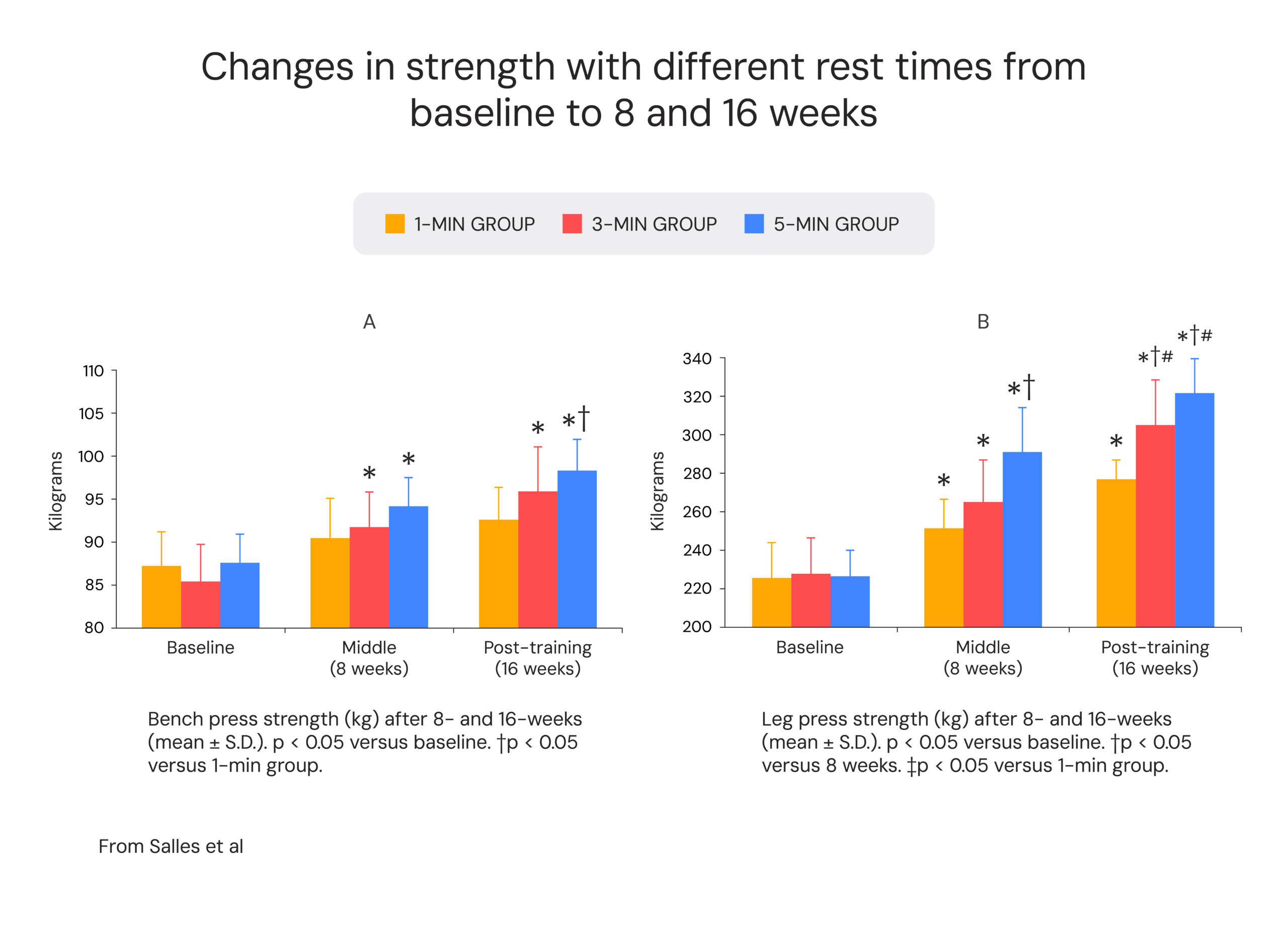
Overall, there’s a good body of evidence showing neutral to positive outcomes for strength with longer rest periods (here, here, and here). Some studies show clear benefits, while others show similar strength gains between rest intervals. But I’d say the most important point is that when we move from acute performance to long-term strength gains, we get a better sense of what rest times may be doing in real life programs.
That does not mean everyone needs to rest 5 minutes between every set of every exercise. But if you’re pushing near-rep-max heavy compound lifts, you might want to give yourself more than a few minutes. If you’re going for a hard 3-rep set on deadlifts, 3 minutes might not be enough. You might need 5, 6, or even 8 minutes before your next set is actually productive.
| Key takeaways for rest times and strength | |
| Question | Practical takeaway |
| Are rest times for strength the same as muscle growth? | No. Strength is more directly tied to performance, so we should give rest times more importance. |
| Do short rest times hurt strength? | They can. Short rest times are more likely to hurt heavier compound lifts where more recovery is needed before the next set. |
| Do longer rest times help strength? | Often, yes. The more time you have to recover, the less likely rest time is responsible for hindered output and performance. |
| How long should you rest? | For strength, 3-5 minutes is a practical range to start with. Harder sets may need more, but more isolated exercises could need less. |
| When should you rest longer? | Rest longer if the next lift needs more intensive focus and technique, you’re feeling shaky, or you’re going for heavier numbers on bigger compound sets. |
Practical tips for understanding rest between sets and time saving tips
I hope I’ve driven home the points about why you may or may not need more rest time between lifts, now let’s help you apply this to your actual training sessions.
What to think about before your next set
Whether you use fixed rest times or self-selected rest times can really come down to preference, your training goals, and your ability to tell when you’re actually ready for your next set.
In practice, many people probably use some form of self-selected rest. You finish a set, wait until you feel ready enough to go again, and then start your next set. That can work perfectly well, especially if you’re honest with yourself and your performance is moving in the right direction. However, fixed rest times can be useful if you tend to rush your sets and/or your progress has stalled.
So, instead of treating rest times rigidly, I think it’s useful to learn some physical cues so you can use a mix of that knowledge with tracking your data over time (and get a real feel for what’s working for you).
For example, let’s say you reach your rest time of 3 minutes and you’re still feeling shaky. If that’s the case, take that physical cue to not rush the set just because your rest time is up. That might sound obvious, but I’ve worked with enough people to know that some lifters will blindly follow rules without understanding their intent. The reverse is also true. If you feel ready to go sooner, especially on smaller exercises or lighter sets, you may not need to wait around just because a timer says so.
So, before jumping into your next set, you can use this quick checklist to decide whether you’re ready to lift again.
| Before your next set | |
| Before your next set | What you’re looking for |
| Breathing | Your breathing should feel steady, and you should not feel winded. |
| Heart rate | Your heart rate should feel closer to baseline. |
| Legs or arms | Your legs or arms should not feel too shaky or weak. A little sensation is fine, but if it feels like too much, give it another minute or more. |
| Technique and performance | Your technique and performance should not feel dramatically limited by the previous set. |
How to organize programming around rest
Rest times are probably not the first thing you think of when you’re designing your program, but they can become an important consideration if you’re short on total training time.
When you plan your training, you obviously want to think about your goals. But you also have to think about your daily logistics, such as driving to the gym, getting dressed, and total training time which should include your rest times. All of that adds up, and it’s not unusual for rest times to get sacrificed in the name of saving time.
With that in mind, let’s look at a few ways to handle this.
1. Consider your goals
Based on what we’ve covered so far, if muscle growth is your goal, you likely have a little more room to play with rest times. If strength is your goal, you’d probably be wise to make more deliberate time for rest between sets.
A good place to start is to ask yourself whether you’re training for strength, muscle growth, or some mix of both. From there, you can think about how much priority your rest times need.
| How to think about rest times by training goal | |
| Training goal | How to think about rest times |
| Muscle growth | Rest times are usually more flexible. You still want to prioritize bigger compound lifts, but smaller isolation movements can often use shorter rests. |
| Strength | Performance is the goal, so rest times need a higher priority here. Your bigger lifts will need the most rest, and you may need to scale rest time based on the demands of your sets. |
| Mixed goals | Give your bigger compound movements priority. Then use shorter rests, or supersets as needed. |
2. Determine your training schedule
Take an honest look at your schedule and what you can realistically give to your training sessions. Throwing together a packed program isn’t going to help much if you constantly end up cutting exercises or rushing rest times.
For strength, it’s better to give your bigger lifts enough time than to force everything into crowded sessions. That might mean training two really good days per week with longer rest times and a stronger focus on performance. Also, keep in mind that strength sessions may require fewer total exercises, as the priority should go to your main lifts.
For muscle growth, you have a little more room to play with organization, but you may also need more total volume across the week.
If you’re really struggling with time, keep in mind that you can also play with your training structure and the number of days you train. Maybe it makes more sense for you to train more days per week with fewer exercises at a time. For someone else, it may make more sense to have 2 longer sessions for their main work and 2 shorter sessions for accessory work.
The point is, don’t feel locked. Rest times are one variable, as is your exercise selection and the number of sessions you have per week.
3. Consider supersets where it makes sense
Another thing to consider if you’re short on time is supersets. If you find yourself cutting out exercises or cutting down on rest time that you think would be better left in, supersets can be a useful option.
If I were writing an entire article on supersets, I would need to discuss a long list of styles and setups. But for this article, I’d like to focus on pairing exercises that don’t (meaningfully) compete with each other to save time while minimizing fatigue.
For example, let’s say your training sessions are full body, and within one session you have a squat, a deadlift, a press, a row, a biceps curl, a triceps extension, and a core movement. If you run through all of those exercises with long rests between every set, the session could get pretty long for muscle growth and even longer for strength. But if you cut rest too aggressively on the big lifts, you may reduce the quality of the sets you care about most.
A possible setup and solution to that problem could look something like this:
| Exercise pairings that may save time | |
| Pairing | Why it can work |
| Deadlift + biceps curl | The curls probably won’t meaningfully interfere with deadlift recovery. |
| Squat + triceps extension | The triceps work should not really limit your next squat set. |
| Bench press + row | These can work well if neither exercise is pushed so hard that it limits performance on the other. |
| Core movement | Placed separately at the end of your session. |
Example of saving lifting time with supersets
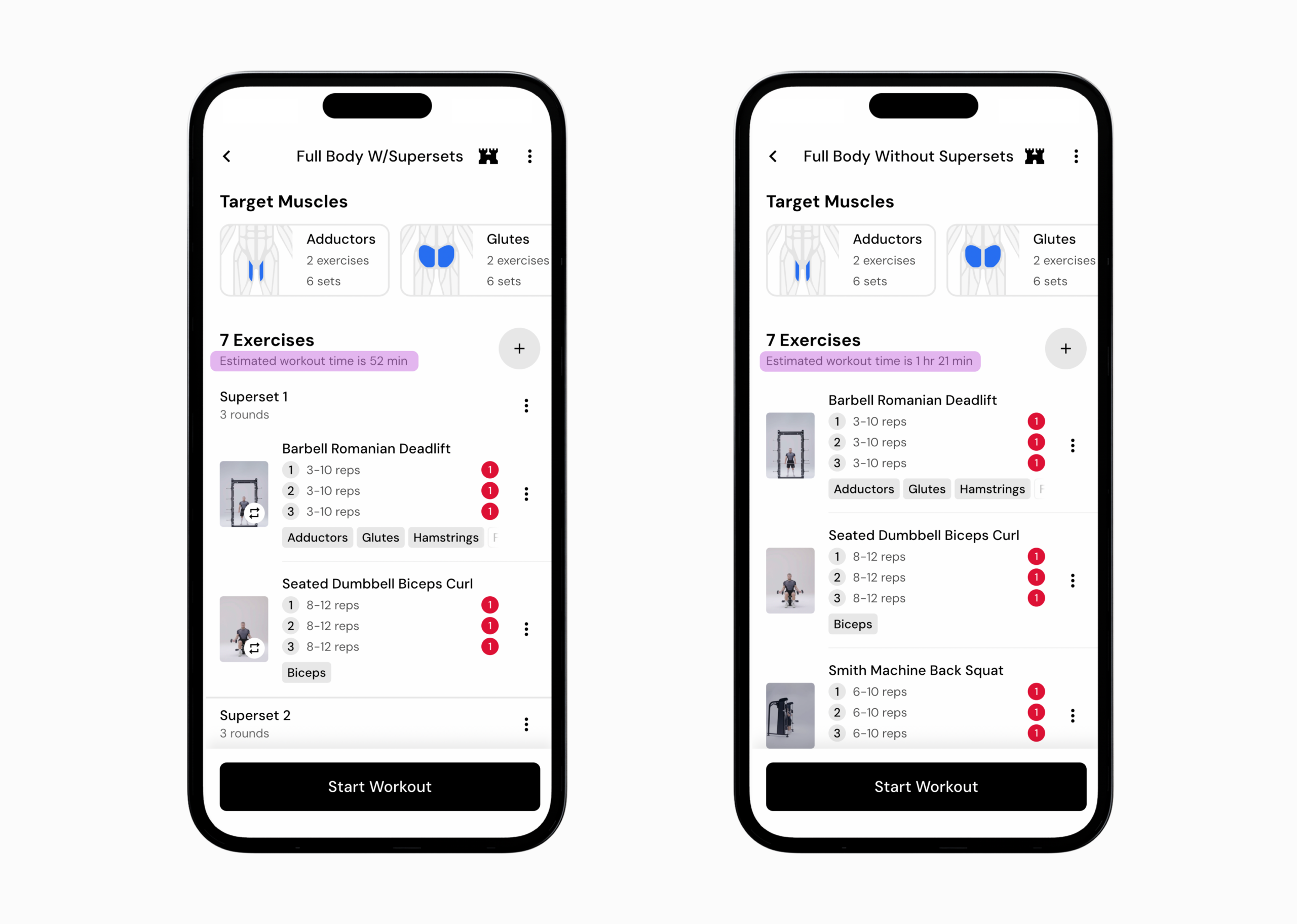
It’s not perfect, but as you can see in the MacroFactor Workouts screenshot above, this kind of setup can save time and allow you to get more work done in a session. I’d still watch your progress over the long term to make sure you’re moving in the direction you want. But if you’re short on time, I’d argue this is usually better than cutting the work altogether.
How to customize rest times in MacroFactor Workouts
MacroFactor Workouts include default rest timers based on the type of movement you’re performing. For example, compound lower exercises default to 3:00, compound upper exercises default to 2:00, and isolation exercises default to 1:30.
You can change those defaults if you need more (or less) time, and you can also set rest times for specific exercises. For example, you might give yourself more time for deadlifts while using shorter rest times for some accessory work.
To change your default rest timers, go to More > Feature Settings > Workouts > Rest Timer > Timer Duration.
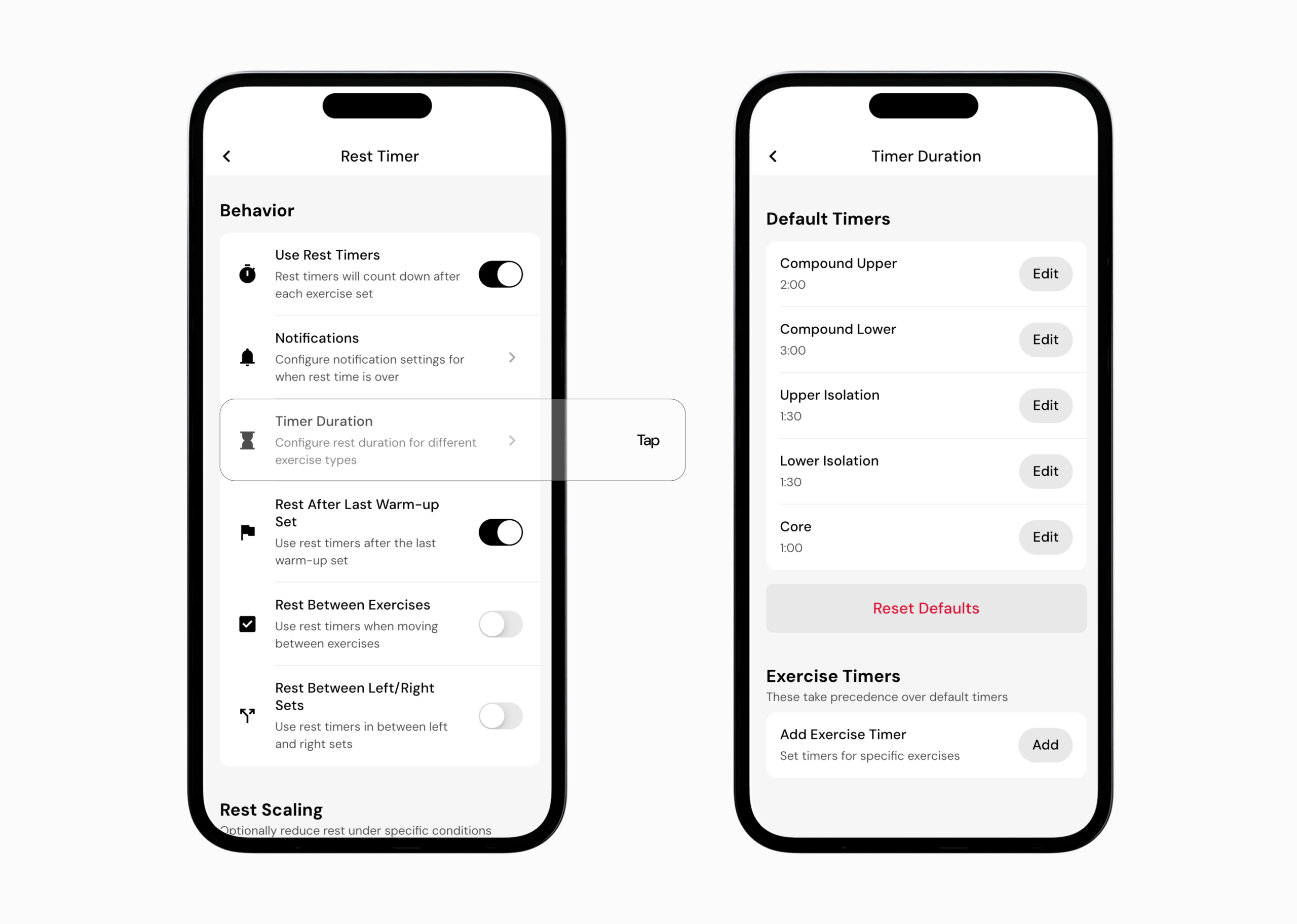
You can read more about the rest timer here and here.
Take home
Rest times do matter, but they do not need to be treated as rigid rules. The right amount of rest depends on factors such as your exercises, training style, and how you handle overall performance during a session.
For muscle growth, there is usually more room for a range of rest times. Many sets can work well with about 1-2 minutes of rest, especially isolation exercises or smaller muscle groups. Just make sure rest times aren’t limiting volume.
For strength, longer rest times should be a priority. Again, performance and gains over time are the goal, so you want enough rest to perform each set with the force and technique you need. For heavy compounds, start at 3 minutes but be open to 5 minutes or even longer when needed.
The main idea is to avoid letting rest times become a limiter for the work you’re trying to do. Be it rushing your sets or setting up unrealistic programming, just make sure your setup works for your training goals.
| Rest time approach by training situation | |
| Training situation | Rest time approach |
| Muscle growth-focused training | Get enough rest to keep volume and set quality productive. About 1-2 minutes works well, but consider longer rests if needed for heavier compound lifts. |
| Strength-focused training | Rest times gets more importance, especially for heavy sets. Start with 3-5 minutes and adjust up or down as needed. |
| Short on time | Use supersets or shorter rests where possible or even fewer total exercises instead of rushing your lifts. Play with your program design if needed. |